Saturday, 20 April 2013

Borderlands

On the road to Tromsø it is possible to take a left and drive instead to Finland. That's what we did last Monday. On the way, I bought two CDs from a petrol station: A Rock n Roll box-set and the second album by Norwegian band Harrys Gym. I had never before noticed how unbelievably middle aged and straight Bill Haley sounds on Rock Around the Clock. You can virtually hear the cardigan the man is wearing. Harrys Gym on the other hand, I recommend for any time you might be crossing a Nordic border. 


Driving into Finland really demonstrates the essential weirdness of national boarders. The road is long, the landscape doesn't change, but you drive past a large sign and a small cabin and suddenly the language on the signs is totally unintelligible and the notes and coins in your wallet are of no use to you. The speed limit suddenly goes up to 100, which is exciting for those of us who live in Norway and are usually supposed to drive at 80kmph. I put my foot down immediately.


To the right of the road there is a large, frozen lake and a flat expanse of snow. People ski across it to get to the point where three countries, Sweden, Norway and Finland, all meet. This meeting point is marked by a raised concrete circle which has been photographed many times for use on postcards.


A little way into Finland there is a tourist centre where they sell burgers, souvenirs and postcards. No such thing on the Norwegian side, I noticed. I think they make their money partly from the fact that snow-scooter regulation is much less strict on that side of the border, so people travel there to ride around in the mountains. It's also a good area for skiing and snowboarding. The man behind the counter spoke Finnish and English, but not Norwegian.
 

Outside, people took off in hang gliders from the frozen surface of the lake and flew off into the distance. We travelled further up the road to where there is a supermarket which is much cheaper than the ones in Norway, though I'm reliably informed that it is way more expensive than anywhere else in the country. We stocked up on a lot of frozen food and I bought Finnish chocolate and some mustard, which I hope is hotter than the stuff we get here. I also bought a Led Zeppelin CD for the journey home.


And then that was it. There was nothing more to do in Finland that day. We got back in the car and drove a few minutes until the ice, snow, rocks and trees around us were once again Norwegian ice, snow, rocks and trees, and the signs said we had to slow our speed right down to 50kmph.


All this just brings home to me the imaginary status of countries. How is it that I walk or drive past this little roadside house, and suddenly I'm in a completely different place? What about a fox crossing through the snow, or a bird flying overhead? Does this madness apply to them too? 


Sunday, 14 April 2013

Arctic Safari

   
Last Thursday some friends arrived on the Hurtigruten from Trondheim. We met them when the boat came into the harbour in Skjervøy at about 11pm. Skjervøy is an island town, and connecting it to the mainland is a bridge with a long single-lane road across it. I remember being in the passenger seat across that bridge in high winds on the day we first set out to find our new home in North Norway. That day it seemed we were driving insanely high up. This time I was driving, and though the bridge isn't quite as altitudinous as I recalled, you certainly wouldn't want to fall from it.

The weather is getting warmer now. The road surface is turning from a layer of ice to a blanket of slush, so careful driving is required. The sun sets late, but by the time we left Skjervøy it was dark out. A little after the bridge, I was rounding a corner when I sensed some movement out of the corner of my eye. To the right of the road, on a snow-covered slope, some dark shape was heading downwards. I slowed the car as a massive animal loped into the road just metres ahead of us. It's difficult to be objective, but this thing seemed bigger than the car (and we drive a Chrysler). Its head was enormous. Where antlers would normally be it had a pair of stumpy horns.

This was the first moose I've seen since I moved here a year and a half ago. Marthe reckons it was a young male. I've been waiting impatiently to see a moose for some time now, so any shock I might have felt evaporated with gladness. There are loads of them up here. 16 have died in car accidents on one local stretch of road alone since the start of this year. Yet somehow, until last week, they had always avoided me among the trees and out in the darkness.

The moose turned away from us and looked around. It seemed confused to be in the middle of a road. It was perhaps a little lost. Then, clumsily, it clambered off the other side of the road and disappeared into the night. I drove on, unsure if the moose's mother, brother or friend might suddenly throw itself in front of the car.

Another 20 minutes down the road and we saw two more! One moose was waiting for the other to climb out of the road and join it in someone's garden. Then the northern lights grew visible in a patch of sky beyond us, and the closer we got to home, the larger they grew. On the long road to our house, I pulled the car over and we got out. Two shifting pools of green light were visible above us.

On the final stretch of road, a bright white arctic hare jumped out and ran through the light cast by the car. It was close enough to clearly see, but far enough away that we were in no danger of hitting it. I have been wondering recently when the hare would come back. He used to visit our garden last spring, and turned from white to brown to suit the summer when the snow was gone.

If I hadn't been there to experience it with them, I could almost have been jealous of our two visiting friends. It was as if this whole place woke that night to welcome them.

Sunday, 17 March 2013

From Sun-up to White-out


People in the arctic spend a lot of time looking forward to the midnight sun, so it can be tough when for half the summer it is obscured by clouds. The end of the dark time was an eagerly anticipated event this year. But when the sun first returned, back in February, it did so under cover of a snowstorm, and it stayed there for several days. When the weekend came, Marthe and I went out for a walk on the mountainside and finally saw the light return. I got my shadow back and the world went technicolour once more. Now the days are only a little shorter than the nights. It's incredible, how fast it turns around.


The weather has been serious of late. Whole weeks of near constant snowfall, broken up by wonderfully clear, cloudless days. Sometimes the wind and the snow together contrive to blot out the whole world. Last weekend we were driving home and the road disappeared completely. You were lucky if you could see as far ahead as the next roadside visibility marker. We drove into a couple of snow banks, but managed to make it home, unlike one unfortunate soul who had abandoned a car at the edge of the road. When we passed it, it was already half buried. 

The road on a good day.
One side of our house is now mostly hidden. The view from our kitchen window is a wall of snow that reaches up to meet the stuff sliding down from the roof. From above the porch hang icicles the length of swords. When the wind gets up it sometimes throws things at our metal roof, and they clatter across into the trees behind us.

Note: Since these images were taken, it has snowed a lot more.


My friend Bill came to visit recently, and I was hoping he would get to see the aurora borealis, but he mostly saw vast amounts of sleet, rain and snow. I haven't seen so much of the Northern Lights this year in general. This is partly because our house doesn't look out into an expanse of sky like the old one did. I've recently realised that on clear nights they are often directly above our house, so I need to go out and check more often. 


Bill Kenny and me cooking lunch with petrol.

I just finished a long Norwegian project on Knut Hamsun. Everyone has to do some self-directed coursework in the third year and I chose to write about three of Hamsun's early books: Hunger, Pan and Victoria. Although Hunger is the most famous one with English speaking audiences, and is an excellent book, I really recommend Pan. It's quite unlike any other book I've read, especially from that period. It was interesting writing at length about literature in another language. I'm hoping now that I've got that out of the way, I can update here more than once a month.

In other news, young goats are being born! Marthe doesn't work in the barn in the winter, but she went to visit the little ones. I suppose this means that spring is close at hand.


Saturday, 12 January 2013

January - to the sun and back


I think we can all agree that T.S. Eliot was talking out of his neck when he said that April was the cruelest month. Every year, no matter where I am, January is a slow-moving, washed-out nightmare of a month. It's been a little better since I stopped treating Christmas as a 14 day drinking marathon, but I still feel like I carry this month around in my chest as a solid and unwelcome sphere of blue.

Still, the days are already getting lighter here in the far North. The horizonal light appears some time around 10.20 and by lunch time the mountains and fjord are washed in silver. There are touches of pink in the sky and the snow is a cold, cold shade of blue. There's a platform of crystaline ice by the waterside. I know I'd rather be dealing with the year's awkward birth here than sitting on the platform at Streatham Hill station. 


We went away for Christmas this year. We spent it in the sunshine (or at least the daylight) of Madeira, 700km from the coast of Africa, 900 from Portugal. It was a surreal experience to see large butterflies dancing through the air on Christmas Eve. Madeira is a place that takes the season seriously, with illuminations, decorations and music, and the Funchal authorities had organised a lot of street performances by dancers and musicians. The programme was a mixture of local folk styles and Christmas standards. Having these performers playing in the background whenever we passed through town was a real highlight, although I wonder why the warmer countries don't write some alternative Christmas songs. It seems a little weird to sing "May all your Christmases be white," to an audience of people who are hoping the temperature won't drop below 20 degrees centigrade.


The landscape of Madeira is unlike any other I know. It's a volcanic Island and in places it shows. The rocks jut out at the coastal edge as if they were frozen in the act of self-creation, and you can clearly see the different layers of lava. 


And yet it's a lush, green, verdant place. The two botanical gardens above Funchal are both, in their very different ways, spectacular. When you follow the levadas (the man-made irrigation channels) through the valleys between villages you find farms set into mountain sides, the fields staggered in a series of steep steps. Dense masses of banana trees can be seen everywhere.  


Lavadas are often cut into the cliff-face and have a sheer drop on one side.
Botanic gardens


In Funchal there is a yellow coastal fort which is open to the public and part of which has been turned into a contemporary art museum. 


While we were there the museum had a retrospective of prints by Ilda Reis. Reis is dead now, but she had a 30 year career in the late 20th century using a variety of different engraving and printing techniques to make complex, abstract, ink-based print works, many of which take a lot of studying before they open up to the viewer. They are often less abstract than they first seem and they have a broad visual vocabulary. Some seem to reference images taken from microscopes—images of cells, small organisms and the building-blocks of life. Looking at her work is a contemplative and personal experience, like reading poetry. It seemed so far removed from most of the contemporary art I'm accustomed to seeing in London galleries, and it struck me as a different path art could have taken— less to do with performative posturing, more quietly musical.

Coming back from Madeira, we discovered that a storm had torn through Nordreisa and ripped our chimney from the roof of our house, so we can't use our fireplace. To take an optimistic view of this, losing our fireplace has given us cause to be glad about what would otherwise be terrifyingly warm weather for the arctic in deepest winter. It's hardly dropped below minus 4 these last two weeks, so we're in no danger of freezing as yet. 


Spot the chimney. Clue: It's not on the roof.

On returning we also discovered that I had managed to disconnect the freezer before leaving for our holiday. We came back to a metal box full of rotten food. The saddest thing about this was that Marthe spent a lot of time in the autumn picking berries to cook with, and now they are all lost, along with enough food to last several weeks. Bagging up endless amounts of nauseatingly rancid mulch is as dispiriting a start to the year as any, but I thought to myself while we were doing it that ultimately I was obscenely fortunate to be able to lose so much food without fear of starving to death. 
 
Arctic night is more severe when you drop yourself into it suddenly. When it comes on gradually it feels natural, but after 10 days in the sun, coming back to near constant lightlessness was like walking into a wall. I can feel it getting easier already though, as January always does. The fjord is calm outside the cabin window. The sun is close enough that the most distant patch of sky is the colour of day. Though I have work to do, my time is my own.

Here's wishing you a gentle start to the year. There's no reason 2013 can't be a good one.


With love, Vince.


Friday, 21 December 2012

Happy Christmas


This is just a very quick post to say Happy Christmas or Winter Solstice to readers of this blog. Thanks for a good year. I hope 2013 brings you new experiences, interesting discoveries and wonderful events.

I'll be back in January.

V.

x

Tuesday, 27 November 2012

Arctic Dusk


This is proper winter now. The sun has gone. No more sun this year. We still have some hours of light each day, but the sunrise bleeds into sunset which fades into darkness. 


I was driving home at 11.30 and looking at the unreal light-blue of the fjord and pink wash of the sky. I thought to myself that these were colours which ought really to have their own names. I never saw them before I moved here. I went outside with a camera to photograph what I could, slipping twice on the ice at the edge of the fjord. From next week until spring all pictures will come out in shades of blue.


By two o'clock the moon was high in the sky, reflecting in the fjord and lighting up the snow. Streetlights reflect in the water opposite us, making our cabin feel a little less remote. 


We've been burning up a good deal of our wood supply. Last night we lay in bed with the door open, watching shapes from the flames in the living room dancing on the bedroom ceiling.

When most of the day is dark it often feels much later than it is. You keep thinking it must soon be time to go to bed, but then you look up at the clock and discover it's 6.30 in the afternoon. Still, you get very little done. People go into semi-hibernation at this time of year. Life gets quieter. Sleep is your friend.

Dying For Bad Music

Today Marcus, who runs Dying For Bad Music, wrote a very nice piece about an album I recorded last winter and spring in my house in Storvik and which I put out online recently. This man deserves a great deal of respect for dedicating time and energy to finding and writing about obscure and interesting music.

His site and label are both full of wonderful and challenging discoveries. I sent him a link to my record and he was generous enough to listen to it, to understand it on its own terms and even do some research on me. You can listen to the record and can read his review here. You'll also find a lot of other music which is available for free, alongside all the label's releases. I recommend taking a look around the site. 
 

Wednesday, 31 October 2012

Snow and Time

It started to snow over a week ago. First there was a thin layer over everything and everyone said it would soon melt, but then there came snow storms so heavy I couldn't see a thing when driving home in the dark. Pretty soon everything was covered, the car was frozen shut and difficult to extricate from the driveway, we saw other people's cars in the ditches on the way to work and everybody started wearing their winter boots again.

The view from our porch now

After the first batch of snow


In this part of the world my relationship with the seasons is turned on its head. In England I love the autumn but fear the winter. Here the winter seems like the natural state of things and the summer a weird hiatus. Already the moon is massive in the sky, even in the daytime, and the landscape glows in a dark blue colour all night. As many challenges as the ice and frost bring, I'm glad that I'll be here for another winter cycle.


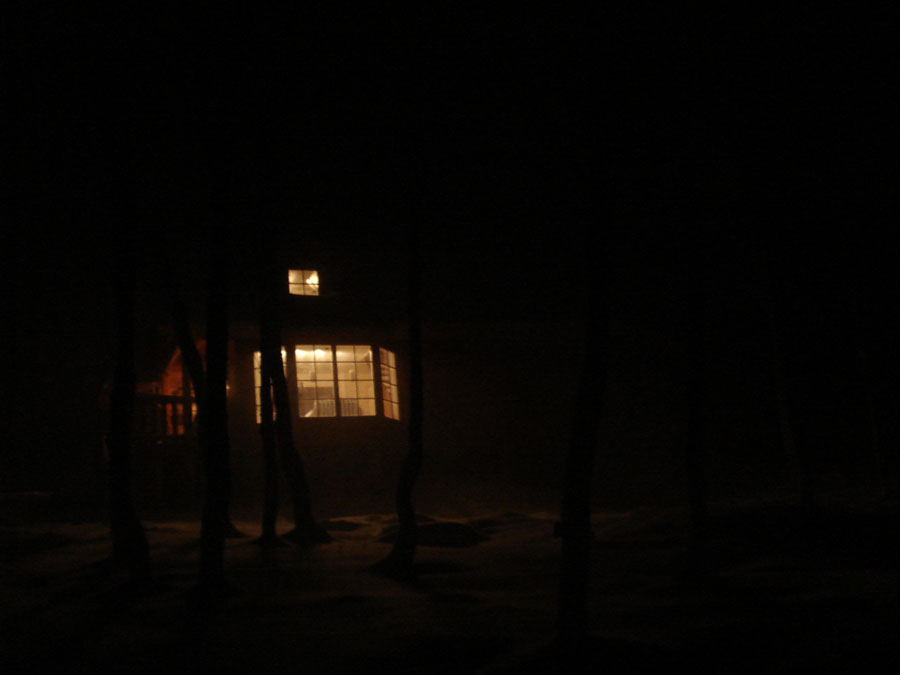
There are no street lights where we live now. To get to our house you have to leave the road and walk down a small hill to the waterside. If we don't leave the lights on it can be difficult spot our home in amongst the trees.


In other news, today is my birthday. That means it's one year since the events I talked about in the first post here on this blog, and very soon it will be a year since we moved here. If I think back to those days before we set off on this trip it feels like a lifetime ago. I think one way to make life seem a little less short is to make sure a lot happens between one birthday and the next.


Monday, 15 October 2012

Lofoten


From the Hamsun centre we drove a little further South and boarded a ferry towards an archipelago named Lofoten. A couple of hours later we arrived in Svolvær, where the ferry's lights picked out circles of rock in the darkness. Just over a year ago we came through Svolvær on our boat trip North and had an hour or so to walk around the harbour. At the time I was really impressed by the look of the Lofoten Suite Hotel, and a year later this was where we stayed the night. Checking in, I thought I must be exhausted, because I found the receptionist helpful but very difficult to understand. Marthe explained afterwards that this was because she was speaking Swedish.

Lofoten Suite Hotel is the one in the middle.


A red-brown cylindrical building studded with massive windows, sitting above two restaurants right by the waterside, the Lofoten Suite Hotel is weird. The rooms have their own bathroom but they share a living room and kitchen with another hotel room. This wouldn't be so strange were it not for the fact that a lot of the walls are made of glass (one of the main views from the balcony was the interior of our bedroom.) It's a bit like We by Yevgeny Zamyatin, except you don't need special permission to draw the curtains. It was the off-season so we had the whole suite to ourselves, which was unbelievably luxurious, but if I ever stayed there again I'd want to be in a group of four so that I would at least know the people in the adjoining room.

All the towns in Lofoten were or are fishing towns and Svolvær is a mix of a modern port and a National Romantic painting. It's so much a place of water and boats that it made me wish my Dad was there, since he has more of a connection with the ocean.


On Saturday we drove through the middle of an enormous mountain and on to another fishing village called Henningvær, which sits on a constellation of small islands at the end of a long winding road and over a long narrow bridge. When local guidebooks compare it to Venice what they mean is that there's far more water than land. 


Driving back we kept stopping to try to take photographs, but the scale of the landscape in Lofoten really defeats amature photography. Even the sky seems bigger.