When everything is covered in snow it's sometimes difficult to remember that snow is made of water. In Nordreisa snow and water are each as much a part of life as the other, but in my mind, until now, they have been two separate things. Water is what lies between us and the mountains opposite. It's what comes down from the spring behind the house for us to drink and wash in. It's what turns to light-blue ice under the bridge or on the road into town where your car goes into the ditch. Snow is what falls from the sky and paints the landscape white. It's what you hike through or ski on. It's the thing that sometimes hides the whole world behind a wall of falling fragments and settles on the roofs of houses and the branches of trees.
We're well past the equinox and the sun makes itself known around 3.30am, setting some time after 10 at night. There aren't many clouds up this way at the moment and the snow is starting to melt. Most of the ice is already gone, but months of snowfall takes longer to thaw. It turns into a blanket of brittle glittering crystals before it finds its way back into being water. Where days ago I could walk on the surface, I now fall through to my knees. Sheets of snow which have been hanging like awnings over the edge of houses fall away. Massive clumps come sliding down off the roof and thump on the wooden boards of the house's veranda, where I sit writing this, wearing a jacket, a hat and fingerless gloves.
Everywhere there is the sound of running water and falling droplets. In the distance I can hear sea gulls laughing. These last two weeks there have been birds everywhere. Snow sparrows have appeared, little black and white birds which flit around in groups, and there seems to have been an increase in eagles. All types of water fowl have appeared in the fjord, including some mallard ducks of the kind I used to feed as a child in Swindon's Queen's Park. In the fjord last week we saw either some kind of small dolphins or very large fish which kept breaking the surface of the water around sunset. There was also a theory that they might have been otters, because our neighbours have seen an otter making its way through our garden. So I guess I'm not much of a naturalist if all I can tell you is "there was something down there in the water," but it was quite a sight and that night I dreamt of porpoise and otters the size of sea lions.
All this and the light constantly refracting on the water tells you winter is truly over. We've made it through our first arctic winter. And you know what? It really wasn't that bad.
Sunday, 22 April 2012


Wednesday, 4 April 2012
Easter Skiing


Skiing at Easter is a kind of tradition in Norway. Outside today there is a constant heavy snowfall, but yesterday the sky was cloudless. We went 13km, give or take. That's not too bad considering I've never gone cross country skiing before.
Wednesday, 28 March 2012
Alta: Finnmarksløpet
Finnmarksløpet is the world's northernmost sled dog race and it ran for the first time in the year I was born. There are two routes, both starting and ending in Alta, the longer of which goes across to Kirkenes, a town which lies north of Finland and just west of Russia. People come from all over to take part in the race, and this year we were in Alta to see it start too.

We booked a suite in the Park Hotel, a place so nice we decided to stay an extra night, and it turned out that our hotel room had its own roof-terrace overlooking the main street. On Friday night and Saturday morning people brought in and laid extra snow, cordoned off the street and made a track for the dogs with a big inflatable starting gate. Just around breakfast time the race officially opened and a warm-up man came out and did a set of weird and unfunny, somewhat adult oriented jokes to the child-heavy waiting audience.


At around 11 the sledges and dog teams made their way out from the nearby car park, crossed a road and lined up along the track. One thing was clear: while the atmosphere was pretty good on all sides, nobody was quite so excited as the dogs were. These dogs really wanted to start their running. I was surprised at how normal they seemed. Some of the dogs looked like you might expect a husky to look, but many others looked more like a dog I would expect to meet in a local recreation ground than in the pages of Call of the Wild.


For much of the afternoon the competitors took off one by one. I can't claim we saw them all, but we watched a fair few. The longer race went on for around a week and was won this year by Inger Marie Haaland. This made her the second woman to win. You can see a couple of pretty amazing images from one of the chekpoints on Jan Georg Svane's Flickr.


We booked a suite in the Park Hotel, a place so nice we decided to stay an extra night, and it turned out that our hotel room had its own roof-terrace overlooking the main street. On Friday night and Saturday morning people brought in and laid extra snow, cordoned off the street and made a track for the dogs with a big inflatable starting gate. Just around breakfast time the race officially opened and a warm-up man came out and did a set of weird and unfunny, somewhat adult oriented jokes to the child-heavy waiting audience.


At around 11 the sledges and dog teams made their way out from the nearby car park, crossed a road and lined up along the track. One thing was clear: while the atmosphere was pretty good on all sides, nobody was quite so excited as the dogs were. These dogs really wanted to start their running. I was surprised at how normal they seemed. Some of the dogs looked like you might expect a husky to look, but many others looked more like a dog I would expect to meet in a local recreation ground than in the pages of Call of the Wild.


For much of the afternoon the competitors took off one by one. I can't claim we saw them all, but we watched a fair few. The longer race went on for around a week and was won this year by Inger Marie Haaland. This made her the second woman to win. You can see a couple of pretty amazing images from one of the chekpoints on Jan Georg Svane's Flickr.
Tuesday, 20 March 2012
Alta: Borealis
Alta town centre looks a bit like the buildings have been dropped in by air-lift. Around it the residential areas are hidden amongst trees or over small hills, leaving in view only box shaped shopping centres and car parks which give the impression of a kind of sci-fi wild west in the northern wastelands. In the main square between all these blocks of glass and concrete, Laila Kolostyak had built an ice garden. There were strangely shaped snow-penguins with glowing eyes, a dragon which children could climb inside, an igloo and a massive ornate stage made of snow and ice.

After night fell, local children and teenagers put on an abstract movement piece, the story of which was (and I have since read a suggestion that this interpretation is completely wrong, but trust me dear reader, this is how it was...) a tale of a young warrior from the orient who travelled around the northern areas of the globe, collecting elements of the northern lights in a magic cake tin and braving dangers, such as wolves and belly dancers. At the end the warrior opened the cake tin and released the aurora borealis, at which point the rest of the cast came back on stage for their bow, creating a complex tableau in the process, and at the same time people at the back of the crowd let go of a large number of coloured helium balloons with glow sticks hanging from them which floated up into the sky. I told myself not to worry about the plastic, we're in the middle of nowhere up here, it's a drop in the ocean.


The whole thing was a great example of what can be achieved when amateurs and professionals get together to produce something for the community. My personal highlights of the performance were a large bird puppet, the symbolism of which I couldn't fully grasp, but which looked great on the two occasions it circled the action, and the music which accompanied the final section of the performance. This was a kind of Sami joik (a form of traditional singing not too far from yodeling) with a seriously banging beat and bass line underneath it. I would love to know what this piece of music was, so if you know, please get in touch!

Friday, 16 March 2012
E6 to Finnmark
Last weekend we drove to Alta, the largest town in Finnmark, which is the only Norwegian principality further north than the one we live in.
The first part of the journey took us over Kvænangen mountain. Marthe drives that way to work sometimes but I had never been up there before. It was a sunny day and once the road leveled out towards the top we stopped the car and I ran out into fields of snow. In no time I was almost knee-deep. There is no sound up there at all. There is wind all around, but somehow it seems noiseless.


Further on we found a small road which turns off towards Øksfjordjøkulen. That's a glacier which calves directly into the sea and which we saw on the map before we moved here. Until recently it was too dark to make the trip. We ran out of road and parked beside what appeared to be a fish factory closed for the day, then we walked along the side of a fjord until we came to a tiny collection of houses, some boarded up toilets and a sign telling tourists that they were a four hour walk from Øksfjordjøkulen. We climbed up to a natural observation point. The glacier was imbedded in the mountain on the other side of the fjord, a translucent blue under a cover of snow. You can see it in the picture below, up in the background to the right of the yellow house, though the light it holds is a little lost in a photograph.


And so we retraced our steps and drove on into Finnmark, but it was a busy weekend, so I'll follow this post up with two more soon.


The first part of the journey took us over Kvænangen mountain. Marthe drives that way to work sometimes but I had never been up there before. It was a sunny day and once the road leveled out towards the top we stopped the car and I ran out into fields of snow. In no time I was almost knee-deep. There is no sound up there at all. There is wind all around, but somehow it seems noiseless.


Further on we found a small road which turns off towards Øksfjordjøkulen. That's a glacier which calves directly into the sea and which we saw on the map before we moved here. Until recently it was too dark to make the trip. We ran out of road and parked beside what appeared to be a fish factory closed for the day, then we walked along the side of a fjord until we came to a tiny collection of houses, some boarded up toilets and a sign telling tourists that they were a four hour walk from Øksfjordjøkulen. We climbed up to a natural observation point. The glacier was imbedded in the mountain on the other side of the fjord, a translucent blue under a cover of snow. You can see it in the picture below, up in the background to the right of the yellow house, though the light it holds is a little lost in a photograph.

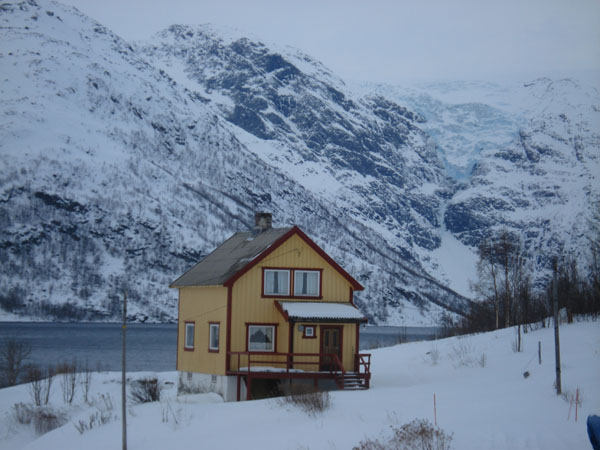
And so we retraced our steps and drove on into Finnmark, but it was a busy weekend, so I'll follow this post up with two more soon.


Saturday, 25 February 2012
Ben Washington and the Mystery of the Buried Treasure
Just over two weeks ago we had our first visitor from England. My friend Ben came to see us and to find out what it was like up here. It made sense to me that he would be the first person to come and visit, since he spends his life on little adventures. They often find their way into pieces of sculpture.
Ben arrived at night, and I was excited on his behalf that he would wake up alone in our house and step out into this landscape in the morning. Later in the day, when I was back from work, we spoke about the environment here. "It's not really anything you can talk about," he said. "You just go out there and you look at it, and you just get it. It's not something you can express." I said I thought it was something that changed with time, that when I had come here I hadn't really understood it at all, having lived so long in the city, but that I felt I understood a little more about it now, and that it was something I was constantly learning.

Ben and I hiked over the hills, from where you can see the mouth of the fjord to where Marthe and I live. The sun went down as we passed the place where I lost my keys and we walked the last stretch through the forest in darkness. We talked about England and how things are there; I felt very much that I might never move back. When I've lived in other places and people have come to visit me I have often seen my surroundings afresh, but that didn't really happen to me this time. Perhaps that's because I haven't been here long enough for it to feel normal yet. But I do feel very at home here now, so perhaps it's just not a landscape you can take for granted.
To celebrate having a visitor, Marthe and I decided that we should try to eat some of the many crabs which our landlord keeps stored in plastic bags in the cellar freezer. Until then I'd had an idea that they would be whole crabs, normal crabs, perhaps the size of a fist. When we got them out of the bags they turned out to be amputated king-crabs' legs, still connected to each other in groups of three - massive bright red monster claws the size of a human head. Frozen, they looked terrifying, like severed alien hands. Ben said they would give him nightmares, but once we'd put them in the fridge to defrost overnight, baked them and hacked our way in with knives, they turned out to make an incredible meal. If you come here, that's what we will offer you.

The day before Ben left, the three of us went out for a walk along the shore of the fjord. At the high-tide point I found an empty bottle with a scrap of paper inside. When we got it open it turned out to be a map showing the location of some buried treasure. We decided to leave the hunt to somebody else, so we put the note back in, screwed the lid on tightly and cast the bottle back out into the fjord.


Ben arrived at night, and I was excited on his behalf that he would wake up alone in our house and step out into this landscape in the morning. Later in the day, when I was back from work, we spoke about the environment here. "It's not really anything you can talk about," he said. "You just go out there and you look at it, and you just get it. It's not something you can express." I said I thought it was something that changed with time, that when I had come here I hadn't really understood it at all, having lived so long in the city, but that I felt I understood a little more about it now, and that it was something I was constantly learning.

Ben and I hiked over the hills, from where you can see the mouth of the fjord to where Marthe and I live. The sun went down as we passed the place where I lost my keys and we walked the last stretch through the forest in darkness. We talked about England and how things are there; I felt very much that I might never move back. When I've lived in other places and people have come to visit me I have often seen my surroundings afresh, but that didn't really happen to me this time. Perhaps that's because I haven't been here long enough for it to feel normal yet. But I do feel very at home here now, so perhaps it's just not a landscape you can take for granted.
To celebrate having a visitor, Marthe and I decided that we should try to eat some of the many crabs which our landlord keeps stored in plastic bags in the cellar freezer. Until then I'd had an idea that they would be whole crabs, normal crabs, perhaps the size of a fist. When we got them out of the bags they turned out to be amputated king-crabs' legs, still connected to each other in groups of three - massive bright red monster claws the size of a human head. Frozen, they looked terrifying, like severed alien hands. Ben said they would give him nightmares, but once we'd put them in the fridge to defrost overnight, baked them and hacked our way in with knives, they turned out to make an incredible meal. If you come here, that's what we will offer you.

The day before Ben left, the three of us went out for a walk along the shore of the fjord. At the high-tide point I found an empty bottle with a scrap of paper inside. When we got it open it turned out to be a map showing the location of some buried treasure. We decided to leave the hunt to somebody else, so we put the note back in, screwed the lid on tightly and cast the bottle back out into the fjord.


That night the Northern Lights came and lit up the cloud cover. We stood in the snow and watched the sky changing colour.
Tuesday, 7 February 2012
Country Folk Are Great
It became clear that our water was not coming back of its own accord. We called our landlord and he called our neighbours. Two local men arrived at our house and set to work trying to defrost our pipes. After a time they realised that the problem lay with the well up on the hill, where we get our spring water. It was frozen and so was the pipe that leads to the house. Lack of snow and temperatures of below -20 will do that.
They called in a third man, busted up the ice with a massive metal stake and set to work with what looked like a home-made defrosting machine. After several hours we had running water again and we were given the job of shoveling snow over the well for insulation, which meant that we didn't feel totally useless. When we thanked them, one of them just said, "Vann må man ha." (One must have water). And off they went into the night.
I don't have any pictures of this process, obviously, but I did get out to take some of the fjord yesterday when it was freezing over in places.


They called in a third man, busted up the ice with a massive metal stake and set to work with what looked like a home-made defrosting machine. After several hours we had running water again and we were given the job of shoveling snow over the well for insulation, which meant that we didn't feel totally useless. When we thanked them, one of them just said, "Vann må man ha." (One must have water). And off they went into the night.
I don't have any pictures of this process, obviously, but I did get out to take some of the fjord yesterday when it was freezing over in places.


Sunday, 5 February 2012
The Ice The Sun The Horse and The Dog
We woke up in the morning and the pipes were frozen. The temperature outside was -18, and the snow hadn't fallen for some time, so it shouldn't really have come as any surprise, but as a child of the late 20th Century I never fail to be appalled by a lack of hot running water on demand. We did all we could to heat up the cellar, where the pipes enter the house. We left all the taps on and we headed out for a walk. Our neigbour, whose husband is away with work, had invited us on a trip up to the frozen lake where the kids go skating at this time of year.
Our neighbours live on a farm with a horse and many goats. When we got over there we found that they had also temporarily adopted a dog. One thing that worries me about farm animals is the way that their faces are like human faces but arranged a little differently; in the case of a horse the head seems much too big and bent out of shape with the nose pushed forward and the eyes to the sides, but basically there's a clear resemblance to a human head. About dogs I only know what I have read in books by Konrad Lorenz, which includes the idea that there are two types. One type is related to the wolf and will accept only one human master in its lifetime (the husky is of this type). The other will naively accept anyone who seems friendly. Our dog, Sheba, seemed to be of the second kind, and she nominated me as her master for the day. With our neighbour's daughter on horseback and with a dog running around me, we set off into the hills.

When we were walking through the the small valley behind our house, Marthe called to me to stop. "Listen to the mountain," she said. It was true that you could hear it. Shortly afterwards the sun broke over the horizon for the first time this year. The first thing I noticed was that I got my shadow back. The next thing was that there were colours I didn't know had gone missing. I had noticed that throughout the dark period all photographs came out looking blue, but I hadn't realised quite what a limited palette I'd been seeing. Yellow and orange were were suddenly everywhere, but also red, some pink, about half the green spectrum, most shades of brown... and that was just looking at the heather on the ground. There was colour everywhere; it was like I'd had my sight partially restored.


When we got to the lake it was a light frozen blue. There were deep cracks in the ice, but I wasn't worried about it breaking, because the horse was walking across it. Other neighbours came with their children and built a fire in a circle of stones. Kids skated, people cooked sausages and we looked out at the view.


The sun was soon gone and it grew colder. I decided to go a little further up a nearby slope and look out across the fjord. The dog, Sheba, came with me. She was faster than I was over the snow, but patient with me. When we got to the top she sat by my side and looked out across the landscape and I understood why it is people go walking with dogs.
The journey back down was not a success. Somehow I took a lot of the slope head-first and after falling for a few meters I hit a tree. I was lying in the snow, the dog was jumping on and around me worriedly, and I heard myself saying, "Man, that really hurt." When I stood up I was pretty dizzy and there were different shades of pain in my jaw, my neck and my back. I found Marthe and we decided to head back to the house and to take our neighbour's daughter with us, as she was crying from the cold.
It wasn't until we got back to the house that I became aware I was missing my glasses and my house keys. I don't think there's any need to lock your house if you live where we live, but city anxieties are hard let go of. We'd left the place intruder-proof. Marthe took our crying six year old friend home while I headed back up into the forest.
The fire was still burning, but the others had left. I made my way up to where I'd hit the tree and I found my glasses sticking out of the snow. I think I might have made a deal with God on the way up without realising it, because the glasses were what I was more worried about. The keys were nowhere to be seen. Marthe arrived and we searched some more, but it was too dark.
We stayed the night at our neighbour's place, where she gave us porridge, we had showers, Marthe drank red wine and I slept for around twelve hours. This morning there were icy gales blowing in across the water and the temperature had dropped to -21. We went up to look for the keys one last time. The winds pushed us across the frozen lake like hockey pucks, we could hardly stand up when searching around the remains of the fire, and the slope where I had fallen was frozen hard.
Back at the house we smashed a window and let ourselves in, just as any self-respecting thief would have done, door locked or otherwise. The pipes were still frozen. We nailed some cardboard over the hole we'd made in the glass.
The winds are still tearing across the fjord. The fire is burning in our stove. They say that the temperature will rise to around Zero on Wednesday, so we hope the taps will then start working.
The journey back down was not a success. Somehow I took a lot of the slope head-first and after falling for a few meters I hit a tree. I was lying in the snow, the dog was jumping on and around me worriedly, and I heard myself saying, "Man, that really hurt." When I stood up I was pretty dizzy and there were different shades of pain in my jaw, my neck and my back. I found Marthe and we decided to head back to the house and to take our neighbour's daughter with us, as she was crying from the cold.
It wasn't until we got back to the house that I became aware I was missing my glasses and my house keys. I don't think there's any need to lock your house if you live where we live, but city anxieties are hard let go of. We'd left the place intruder-proof. Marthe took our crying six year old friend home while I headed back up into the forest.
The fire was still burning, but the others had left. I made my way up to where I'd hit the tree and I found my glasses sticking out of the snow. I think I might have made a deal with God on the way up without realising it, because the glasses were what I was more worried about. The keys were nowhere to be seen. Marthe arrived and we searched some more, but it was too dark.
We stayed the night at our neighbour's place, where she gave us porridge, we had showers, Marthe drank red wine and I slept for around twelve hours. This morning there were icy gales blowing in across the water and the temperature had dropped to -21. We went up to look for the keys one last time. The winds pushed us across the frozen lake like hockey pucks, we could hardly stand up when searching around the remains of the fire, and the slope where I had fallen was frozen hard.
Back at the house we smashed a window and let ourselves in, just as any self-respecting thief would have done, door locked or otherwise. The pipes were still frozen. We nailed some cardboard over the hole we'd made in the glass.
The winds are still tearing across the fjord. The fire is burning in our stove. They say that the temperature will rise to around Zero on Wednesday, so we hope the taps will then start working.
Sunday, 22 January 2012
Djupvik
This week it has been light. No sun yet, but light still. And this has changed where we live.
On Wednesday I went and took a biology course in Norwegian at the adult education centre. I found out I knew woefully little about the workings of the human heart. Walking back into town, I saw an eagle circling up above the mountain and I stopped to watch it for a time. They can move such a distance in such a short time. I felt very earthbound for the rest of my walk.
Living out here, you would think we would be surrounded by wildlife, and we probably are, but we've seen very little because of the time of year. Even the reindeer are elsewhere for the winter. I fully expect to meet more animals as the spring comes.
Today we drove to visit a woman I work with and her husband in a small village called Djupvik. When she was giving me directions to her house she said, "You just follow the road and keep going until you come to a sign which says Djupvik. It's the last house on the left." There is only really one road here. It's called the E6.
We stopped a couple of times on the way to take pictures around a place called Rotsund, which seems like a fishing village. I was using a broken camera and could barely get it to work. In the end it didn't matter so much that I hardly had the chance to take any pictures, because it's difficult to make an ugly photograph there.

Then we drove a little further down the road and found the people we were heading to see. They live in a place where the tourists always stop to take pictures. They have a boat and they go out on the water, where whales swim over to inspect them until they switch off their engine. Moose live behind their house. (I am jealous of anyone who has seen moose in the wild, but everyone assures me I'll see one soon.)
They come from Alaska, but lived in Finland for many years. They welcomed us to their house and gave us coffee and soup. It was a good way to pass a Sunday afternoon.

On Wednesday I went and took a biology course in Norwegian at the adult education centre. I found out I knew woefully little about the workings of the human heart. Walking back into town, I saw an eagle circling up above the mountain and I stopped to watch it for a time. They can move such a distance in such a short time. I felt very earthbound for the rest of my walk.
Living out here, you would think we would be surrounded by wildlife, and we probably are, but we've seen very little because of the time of year. Even the reindeer are elsewhere for the winter. I fully expect to meet more animals as the spring comes.
Today we drove to visit a woman I work with and her husband in a small village called Djupvik. When she was giving me directions to her house she said, "You just follow the road and keep going until you come to a sign which says Djupvik. It's the last house on the left." There is only really one road here. It's called the E6.
We stopped a couple of times on the way to take pictures around a place called Rotsund, which seems like a fishing village. I was using a broken camera and could barely get it to work. In the end it didn't matter so much that I hardly had the chance to take any pictures, because it's difficult to make an ugly photograph there.
 | ||
| Boats Outside Rotsund |

 |
| Mountains Outside Djupvik |

They come from Alaska, but lived in Finland for many years. They welcomed us to their house and gave us coffee and soup. It was a good way to pass a Sunday afternoon.

Saturday, 14 January 2012
Alone in Storvik
Marthe went to England a few days ago, to attend a conference on Arctic photography. It's the first time I've been alone here. Without her I'm reliant on the school bus to get to and from town. I'm usually the only adult on there, watching Daffy Duck and getting carsick with the kids. On Thursday I missed it and had to get a taxi home, which cost 500 kroner (50 pounds). Yesterday I skipped a meeting at work and sprinted to the bus stop as fast as I could. There is no bus at all at the weekend.
I went a little way up the mountain this morning. Not far, because nobody knew where I was. I found a place on top of a rock where I plan to have lunch tomorrow before dark. It's not such a bad thing having no sun when you have a few hours of cold blue light.
Tonight I went out for a walk again, down to the water, to look at the stars in the clear night sky. With the snow on the ground and the lights from the road above, it was bright enough that I could see quite well, but I decided to steer clear of the Ghost House by the shore anyway. I started to wonder why it is that we are automatically scared of old and empty houses, in the same way as we have an instinctual aversion to rats. And why, if ghosts don't exist, do people of all cultures have some concept of them? Basically, I started freaking myself out. I think this is because I'm aiming to write a ghost story soon. Anyway, I started heading up towards the road and just as I was nearing the fence I came across a sheep's skull, half buried in the snow.
It feels really remote here now. It would take me a day to walk to the nearest shop. Since I have more than enough food, that's quite an enjoyable feeling. I tend the fire, read, catch up on emails and letters and play the guitar. I've written a simple piece of music to try to evoke the place where we're living. You can listen to it below.
Storvik by Vince Stephen
I went a little way up the mountain this morning. Not far, because nobody knew where I was. I found a place on top of a rock where I plan to have lunch tomorrow before dark. It's not such a bad thing having no sun when you have a few hours of cold blue light.
Tonight I went out for a walk again, down to the water, to look at the stars in the clear night sky. With the snow on the ground and the lights from the road above, it was bright enough that I could see quite well, but I decided to steer clear of the Ghost House by the shore anyway. I started to wonder why it is that we are automatically scared of old and empty houses, in the same way as we have an instinctual aversion to rats. And why, if ghosts don't exist, do people of all cultures have some concept of them? Basically, I started freaking myself out. I think this is because I'm aiming to write a ghost story soon. Anyway, I started heading up towards the road and just as I was nearing the fence I came across a sheep's skull, half buried in the snow.
 |
| The Ghost House in lighter times. |
It feels really remote here now. It would take me a day to walk to the nearest shop. Since I have more than enough food, that's quite an enjoyable feeling. I tend the fire, read, catch up on emails and letters and play the guitar. I've written a simple piece of music to try to evoke the place where we're living. You can listen to it below.
Storvik by Vince Stephen
Subscribe to:
Posts (Atom)